Parakeet · 2025
A digital soundboard solution, adopted company-wide
Duration
3 Weeks
Role
Project Manager
Team
1 Project Manager, 1 UX Researcher, 2 Developers, 1 Product Designer
Tools
Notion, Github, Figma, Fig Jam, Google Suite
Ending my internship with a challenge
I spent 10 weeks with Viget, a digital agency that specializes in product, design, and development, as a project management intern. During my internship I gained both project and product management skills through focused exercises, mentorship, and involvement in the management of real client-facing products.
Viget's internship program ends in a several-week intern group project, where the cohort works together to ideate, research, design, and launch a digital product.
Historically, this project was co-led by a full-time Project Manager alongside a PM intern. But, my mentor wanted to challenge me and believed that I had the skills to own the project.
I served as the sole PM for the internship project, driving alignment across a cross-functional team and leading the cohort through a full product development cycle from concept to launch.
Digital soundboards lacked Google Meet integration and were difficult to use in live meetings
Viget is a hybrid workplace, where employees span several states and time zones. Despite the distance, Viget believes in building community and maintaining a positive work culture. Their weekly all-hands meeting provides the perfect time to connect everyone virtually, and they aim to keep the meeting fun and engaging. To aid in this effort, Viget wanted to use a digital soundboard to add humor and joy to their meetings through sound effects. However, existing soundboard tools weren't built for Google Meet and were cumbersome to use during live meetings, limiting both usability and reliability.
The problem with existing soundboards
Through initial conversations with our key stakeholders, we determined two key issues with Viget's current setup.
Cluttered UI
Online soundboards usually consist of publicly editable buttons with poor organization features. These soundboards are also dated, and feature a large amount of pop-ups and ads.
No Google Meet Integration
Existing soundboards weren't built to integrate with Google Meet, resulting in inconsistent audio and the need to switch tabs to play sounds across the meeting.
Where we wanted to be in three short weeks
On a product level, success was defined by how the soundboard was adopted and used internally at Viget. Given the short timeline and lack of formal analytics, we focused on observable usage and feedback.
Key indicators included widespread adoption across the company, frequent use during meetings, and positive user feedback.
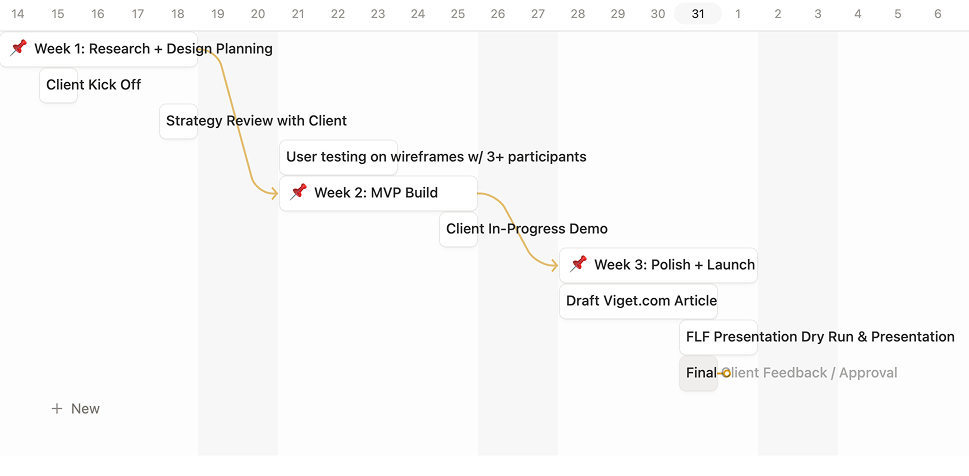
On a delivery level, success was defined by executing efficiently within a three-week timeline. This included maintaining clear requirements, strong alignment across design and engineering, and minimizing ambiguity during implementation to ensure a smooth build process.
Targeting working professionals who want to have fun
Our target demographic was in line with Viget's employees: professionals who wanted to promote a company culture rooted in joy, even if they are separated by distance. We determined two key use cases for our product.
Adding levity as a presenter
User: A remote employee leading an internal meeting or presentation.
Context: Presenting a slide deck or story in a casual, intimate setting.
Goal: Add humor or intrigue to their casual presentation.
Actions: The user has the soundboard available with a list of curated sounds and plays them in real time.
Pain Points: Users experienced variable audio success, which discouraged usage.
Outcome: Users are able to reliably trigger sounds, allowing for timed jokes and light-hearted presentations.
Audience engagement
User: A remote employee listening to an internal team meeting or presentation.
Context: During a live meeting, where quick reactions and engagement are encouraged but verbal interruptions are limited.
Goal: To contribute to the meeting in a lightweight, non-disruptive way using the soundboard.
Actions: The user opens the soundboard, selects an appropriate sound, and responds to the presenter with a sound effect.
Pain Points: Users experienced delays in locating sounds, leading to poor effect timing.
Outcome: Users are able to quickly react during a meeting, increasing audience participation.
Weighing possible features based on user needs
Our initial conversations with stakeholders, as well as additional user research, centered our focus on organization and ease of use.
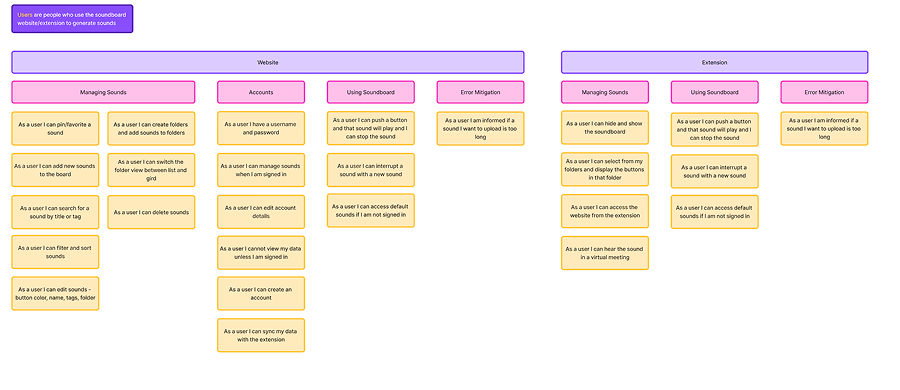
I defined MVP documentation for our product that outlined the features we would prioritize within our solution.
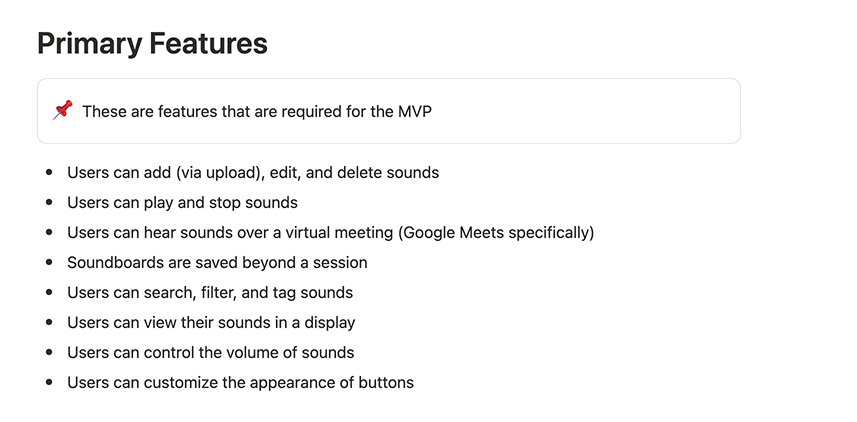
What we weren't building...
Due to the timeframe available, I made the call to exclude two features from our MVP.
Long sound & song integration: The ability to play long sounds through the soundboard was heavily debated between development and design. I made the call to not include long-form audio support in our MVP due to the additional UX problem-solving it would require in order to make the feature functional. Enforcing sound length took less time from a development standpoint than allowing any length song did from a UX standpoint.
Light mode and dark mode: This required a second round of UI design from our product designer, who only had a few days to implement her designs, and it added additional frontend work for our developer with little product benefit compared to other features.
Building our soundboard
My team's developers conducted research on the best way to play audio in Google Meet. They discovered that an extension allows for direct audio injection into Google Meet, creating a seamless soundboard interaction. However, we would be sacrificing crucial screen space for sound organization and creation features. So, I discussed trade-offs with the developers and we came to the conclusion that implementing both an extension and a web page, connected to one backend, was doable and highly advantageous, as long as we were clear about what features belonged where.
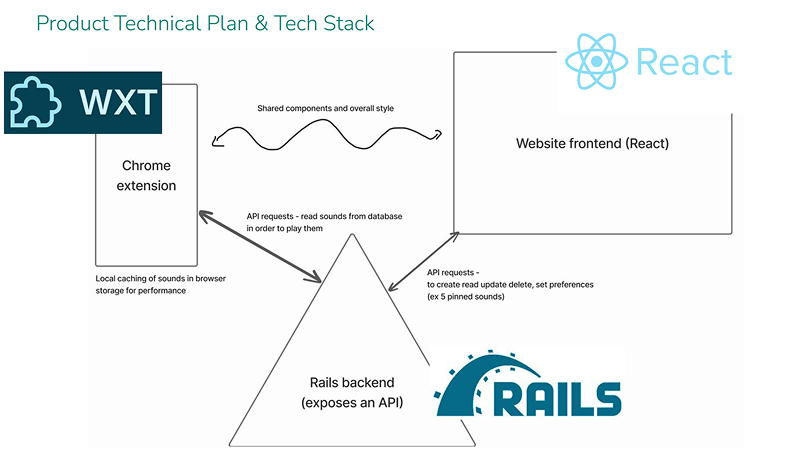
Key Implementation Decision
Following our technical discussion, I defined key user interactions, such as adding sounds, removing sounds, creating folders, and playing audio, and determined which features belonged in the extension or the web page. Doing so ensured all of our features felt intentional and improved development clarity.
Our final product was Parakeet
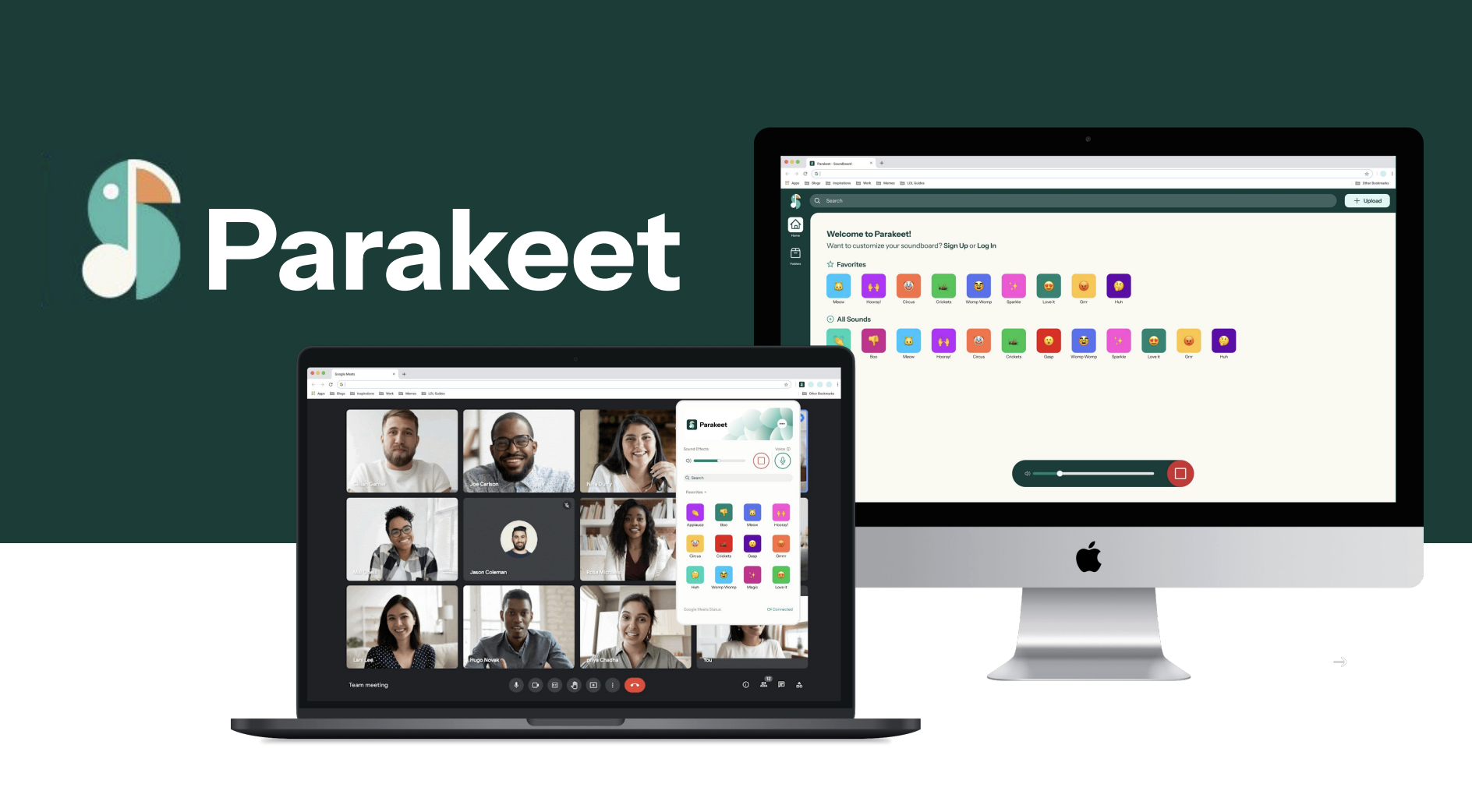
Within our 3-week timeframe, we successfully completed our MVP: Parakeet, a soundboard for brighter meetings.
Feature Highlights
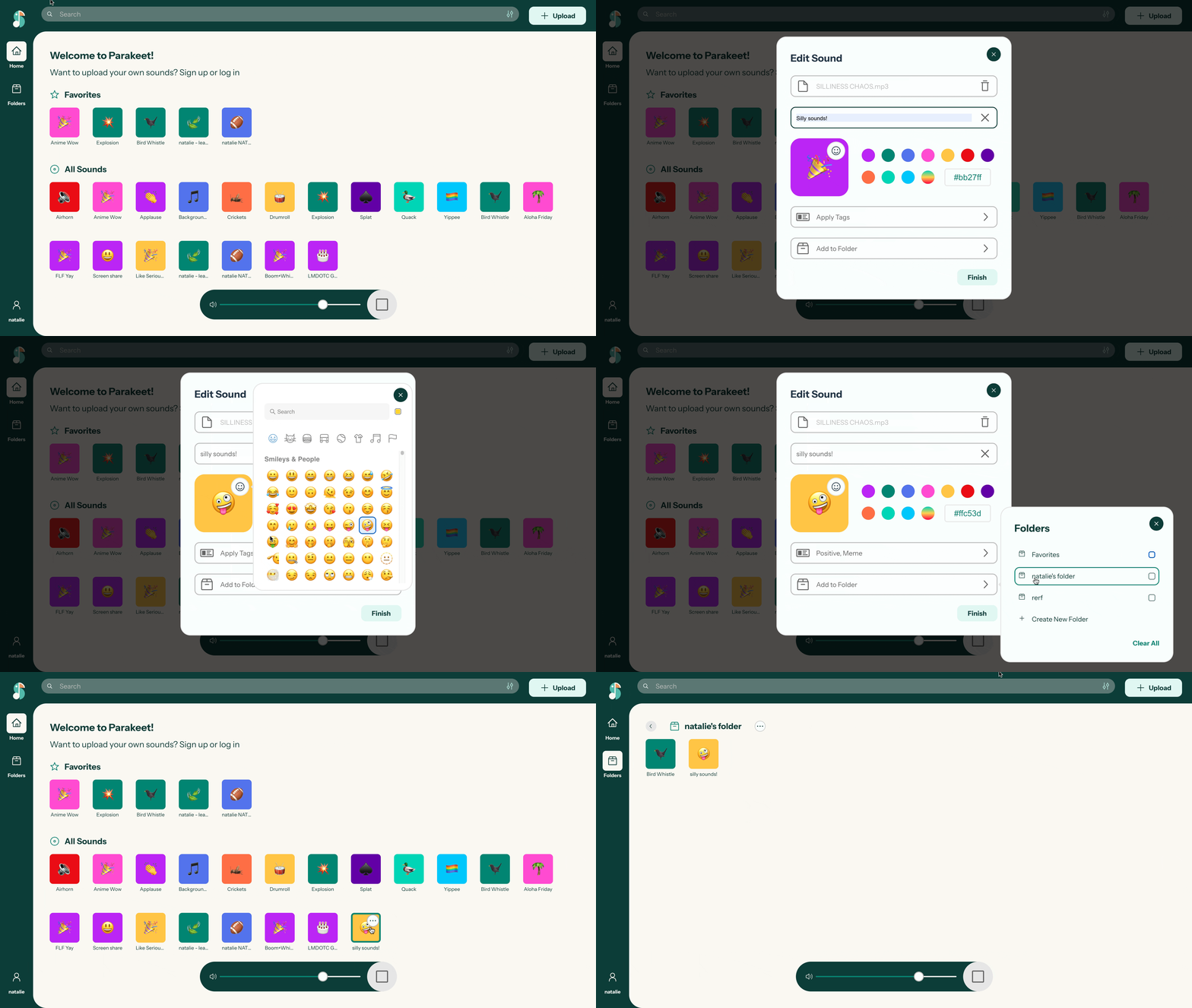
Our website features full CRUD capabilities for adding, managing, and playing sounds. Using the folder system, you can organize your sounds depending on their uses.
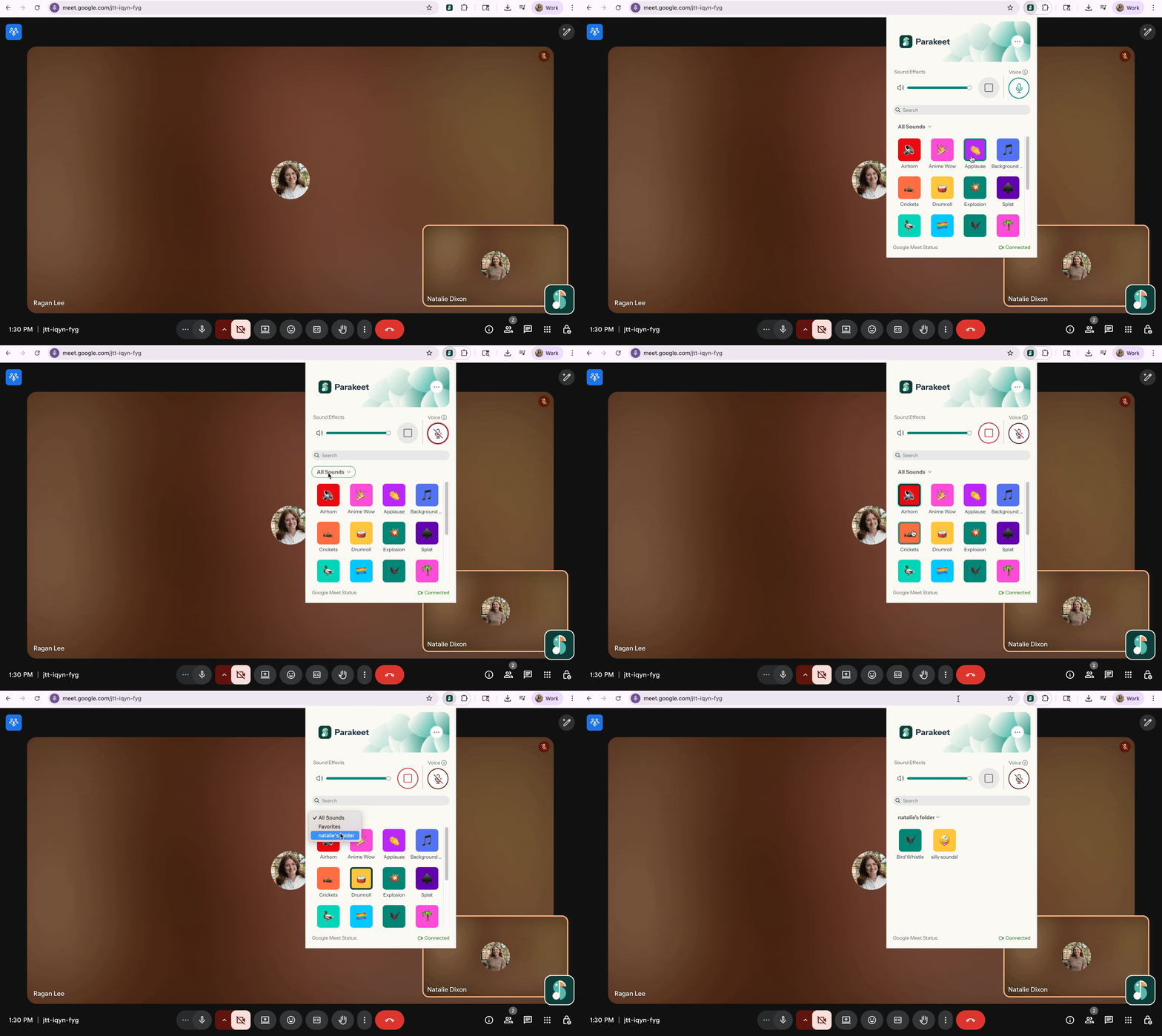
Our extension, once downloaded, is easily accessible from Google Meet without needing to change tabs. You can access all your sounds directly from the extension and can also redirect to the website for larger tasks.
Outcomes
Through careful product decisions and great teamwork, we were able to deliver a complete MVP that resulted in a 100% adoption rate among target users at Viget.
We presented our final product at the end of our internship. Nine months later, it is used weekly by Viget employees in meetings.
In addition, Parakeet is available in the Chrome Store and online for anyone to make an account and use.
What managing Parakeet taught me
Building trust and creating safety within a team lets the team flourish
My teammates praised my ability to lead with empathy and provide an environment where they felt like they could make mistakes, learn, and grow.
As a fellow intern, I was their peer and not an official manager. I led with this mentality and ensured my fellow interns felt respected and trusted.
The mutual respect greatly benefited our process. I found that my team felt comfortable voicing their opinions knowing I had their interests at heart, and they accepted my advice in turn.
Aligning stakeholders and internal teams is a continuous process
I quickly established a system for checking in with my team, and took it upon myself to schedule meetings often, maintain a centralized project timeline, and document every technical requirement. This documentation became the 'single source of truth' that prevented scope creep during our final week.